Reduce key-person dependency – grow your business with automation and AI
Your business should be able to grow without everything depending on you as the owner or a handful of key people.

As the business grows, dependence on key people becomes a bottleneck
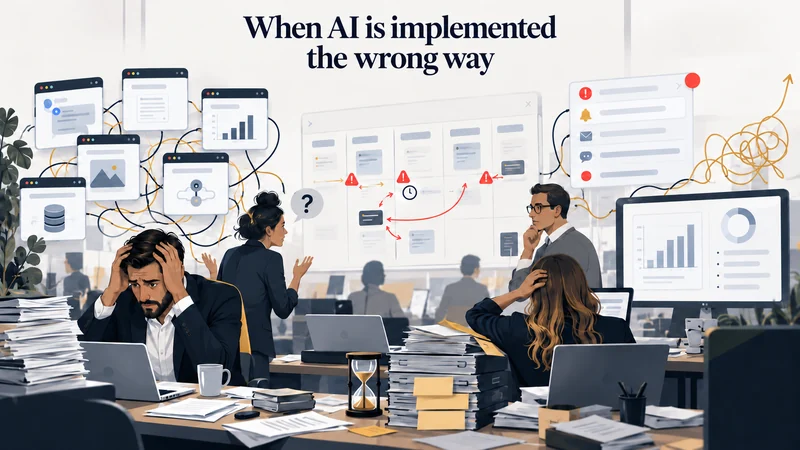
What happens in your business if you are away for two weeks? Does work carry on as usual, or do questions, decisions and customer enquiries pile up until you return?
It is easy to get used to being the person who holds everything together. You know what needs to be done, who can solve the problem and which customer needs an answer today. Your team comes to you because you usually have the answer.
But as the business grows, that way of working becomes more demanding. More customers and more employees bring more questions. Eventually, much of your day goes into keeping everyday operations running.
The same dependency can sit with an experienced salesperson, an administrator or a workshop manager. When essential knowledge exists only in one person’s head, the business becomes vulnerable to absence and harder to scale.
This is where clear workflows, automation and AI can create substantial business value. Knowledge and routines become accessible to more people, while recurring work needs less manual coordination.
What, who, when and how – the foundation of clear workflows
The first step is to understand how work actually happens. For each important workflow, four questions need clear answers:
- What
- What needs to be done, and what outcome should this step deliver?
- Who
- Who is responsible for getting it done, and who takes over when they are absent?
- When
- What triggers the work, and when does it need to be completed?
- How
- How should the task be carried out, using what information and which quality checks?
The answers create a shared foundation for quality. People know what is expected, handovers become clearer and you can see where work gets stuck. To make this effective, the routines also need to be used day to day and updated as the business changes.
Automate the right steps and use AI to support the work
Once that foundation is in place, it becomes easier to decide which steps to automate and where AI can help.
Take a new customer enquiry. In a workflow that depends on individuals, it lands in an inbox. Someone has to read it, remember who should handle it and then remember to follow up. If that person is busy, the enquiry can sit unanswered.
With a clear workflow, the enquiry can be logged automatically and assigned to an owner according to agreed rules. A deadline is set for the next step. If nothing happens, a reminder goes to the right person.
AI can then help summarise the customer’s needs, identify missing information and draft a response. When judgement or approval is needed, a person takes over. Responsibility and oversight must remain clear even when technology carries out part of the work.
You can follow the enquiry’s progress without having to drive every step yourself. The same principle applies to sales, delivery and administration.
More capacity with the same team and less dependence on individuals
At AI Workflow Partner, we start with the way your business works. We clarify responsibilities, identify unnecessary steps and then prioritise automation and AI where they can create the greatest business value. You can start with a single critical workflow and expand once the results are clear.
The aim is for the same team to handle more work while maintaining quality, and for more people to take responsibility without constantly needing to ask you or a key colleague.
That gives you space to lead and develop the business. It also makes growth less dependent on how much you can personally get done.
Start with one question: which workflow would get stuck first if you or your most important team member were away tomorrow?
That is often a good place to begin.