How NOT to use AI in your business
The biggest mistake businesses make with AI is starting with AI.
More tools and faster individual tasks will not help if work still gets stuck between people, systems and decisions.
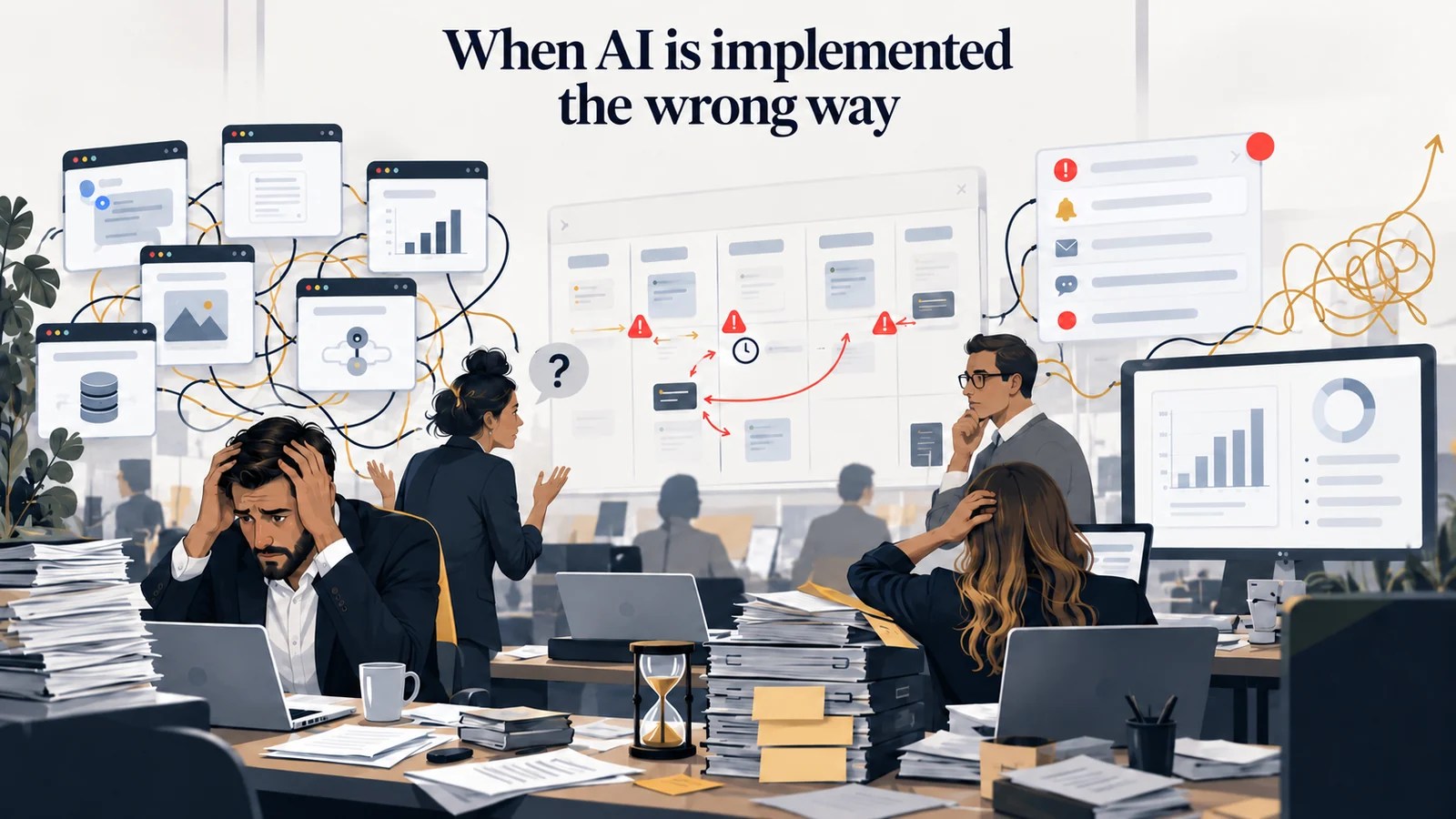
The biggest mistake businesses make with AI is starting with AI.
The race is on.
Businesses are buying AI tools. Building AI agents. Automating customer service. Connecting AI to their CRM. Rolling out copilots. Testing ChatGPT across the organisation.
Everyone wants to move forward. But many are starting in the wrong place.
They start with the technology before understanding how their business actually works.
That is where the problems begin. If ownership, information and handovers are unclear, another AI tool will not automatically make the work better.
McKinsey reports a high failure rate for AI transformations run primarily as technology programmes.
McKinsey · 2026 [1]According to McKinsey, this share of organisations skips breaking down workflows and deciding which tasks belong to people and which to AI.
McKinsey · 2026 [1]Of agentic AI projects are expected to be cancelled by the end of 2027, according to Gartner’s forecast.
Gartner · 2025 forecast [2]These figures cover different types of initiative. Together, they highlight the risk of buying the technology first and looking for business value afterwards.
A broken workflow is still broken when it runs faster
Think about a typical customer enquiry.
An email arrives. Someone reads it and copies the information into a system. A colleague receives a message. Someone else needs to make a decision. The enquiry sits in a queue.
Then more questions come up. Information is missing. Someone searches an Excel spreadsheet. Another email goes out. The customer waits.
Now you add an AI agent that processes the first email faster.
Sounds good. But the rest of the workflow stays the same. The same delays. The same unclear responsibilities. The same information being moved manually.
The difference is that the next person now receives more work in less time.
You have automated a task. You have not improved the business.
McKinsey describes how gains can remain trapped in individual tasks while bottlenecks elsewhere stay in place. An employee working faster does not automatically mean the business delivers faster. [1]
Where many AI projects go wrong
There is rarely a shortage of ideas. The problem is the order in which things happen.
- The tool comes first. Someone sees an impressive AI solution. The business then tries to find a problem it can solve.
- A poor process gets automated. Unnecessary steps, duplicate work and unclear handovers are built into the new solution.
- One task is optimised instead of the whole workflow. One part gets faster, but work still gets stuck further down the line.
- Business value is not measured. More licences and more AI pilots become the evidence of progress. But have you actually reduced lead times, freed up capacity or improved delivery?
- Data and systems are disconnected. Information lives in inboxes, documents and separate systems. AI does not have a reliable foundation to work from.
- Employees are involved too late. The people who know how the work really gets done receive a finished solution instead of helping to shape it.
Gartner identifies data quality, clear business outcomes and behavioural change as central to scaling AI. The technology needs to work with both the information and the people. [3]
So do not start with AI
Start with the business.
At AI Workflow Partner, we begin by understanding the entire workflow. From the event that triggers the work to the result you need to deliver.
We ask five straightforward questions:
- What needs to happen?
- Who is responsible?
- When should it happen?
- How is it done today?
- What triggers the next step?
This reveals delays, duplicate work, bottlenecks and dependency on key people. It shows where information is missing and which steps may not need to exist at all.
Only then do we decide what people should do, what conventional automation can handle and where AI adds value.
Sometimes you need an AI agent. Sometimes a simple automation is enough. Sometimes clearer ownership creates more value than another tool.
The goal is an operational backbone: clear roles, the right information, reliable handovers and checkpoints that keep the work moving.
That is the foundation for getting more done with the same team while reducing dependency on key people.
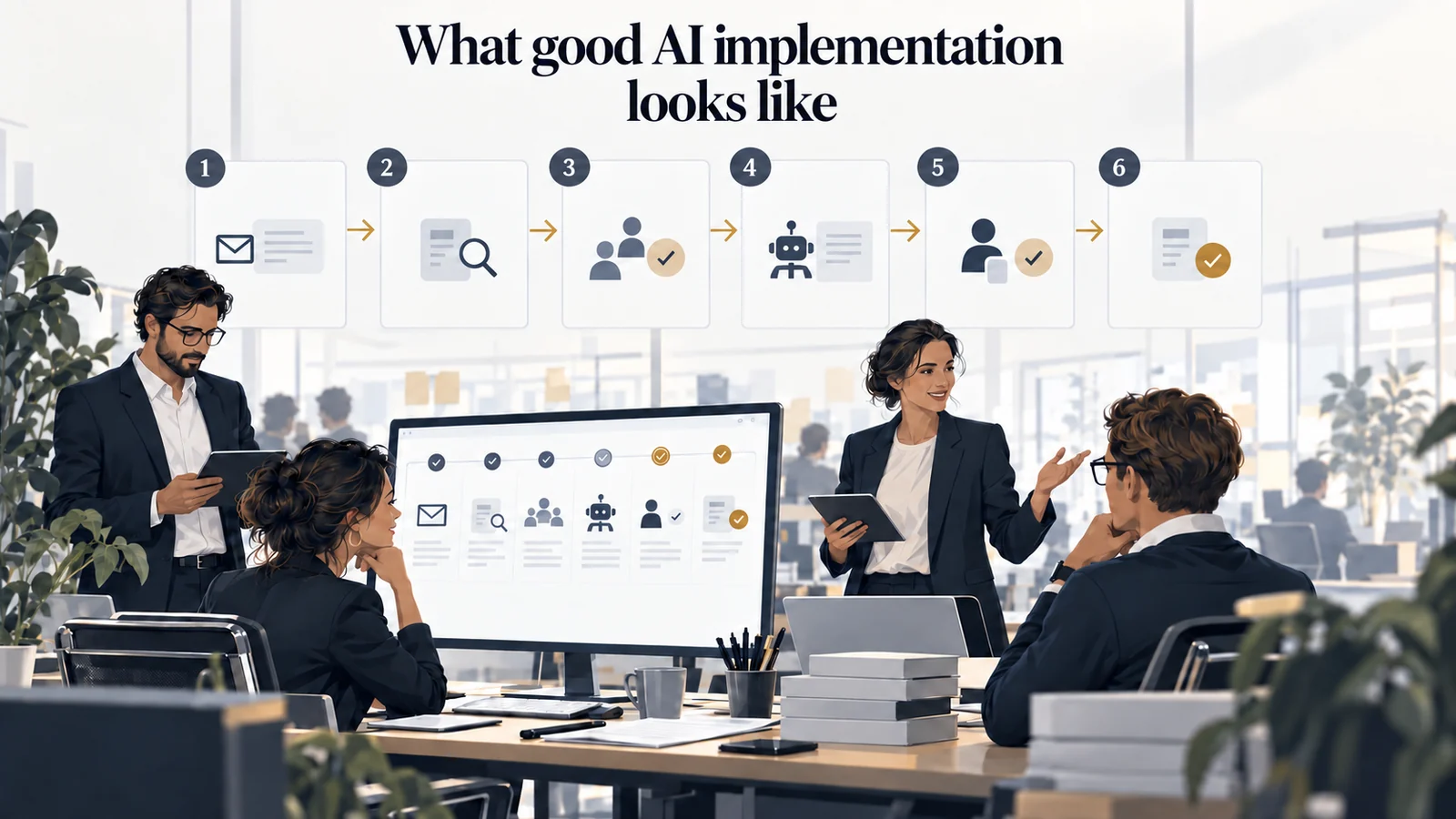
Our work progresses from an initial Workflow Exploration to a detailed Workflow Blueprint, implementation and continuous improvement.
The difference between using AI and becoming an AI-driven business
Using ChatGPT to write an email can be useful. But it does not automatically change how the business operates.
The bigger shift happens when AI and automation become part of everyday work. When the right information reaches the right place. When the next step starts without someone having to remind a colleague. And when people can spend their time on customers, decisions and work that needs their judgement.
The difference is not: “We have implemented AI.”
It is: “We have changed how the work gets done.”
The technology is available to many businesses. How you build your operation around it is what can give you an advantage.
Want to see what this can look like in practice? Explore 10 practical examples of what AI can do in a business.
AI will not fix a poor way of working
AI does not automatically resolve unclear roles, poor processes, dependency on key people, fragmented information or bottlenecks.
In the wrong workflow, it can make those problems worse. More work gets stuck. More errors spread. And the team has more to deal with.
In a well-designed workflow, however, AI can make a real difference: fewer manual steps, faster delivery, better control and greater capacity.
Some businesses are still testing individual tools. Others are changing how the work gets done across the business.
Start with the right workflow. Then build in AI where it makes a meaningful difference.
Sources
- McKinsey: The operating model advantage: Why AI winners are rewiring their organizations · 7 July 2026. Source for the over 80% and 79% figures and the discussion of workflows.
- Gartner: Over 40% of Agentic AI Projects Will Be Canceled by End of 2027 · 25 June 2025. A forecast for agentic AI projects.
- Gartner: Three Areas to Help Data & Analytics Leaders Scale AI · 3 March 2025. Business outcomes, data capabilities and behavioural change.
Over 80% refers to technology-led AI transformations. 79% concerns a step in workflow redesign. Over 40% is a forecast for agentic AI projects. The figures measure different things.